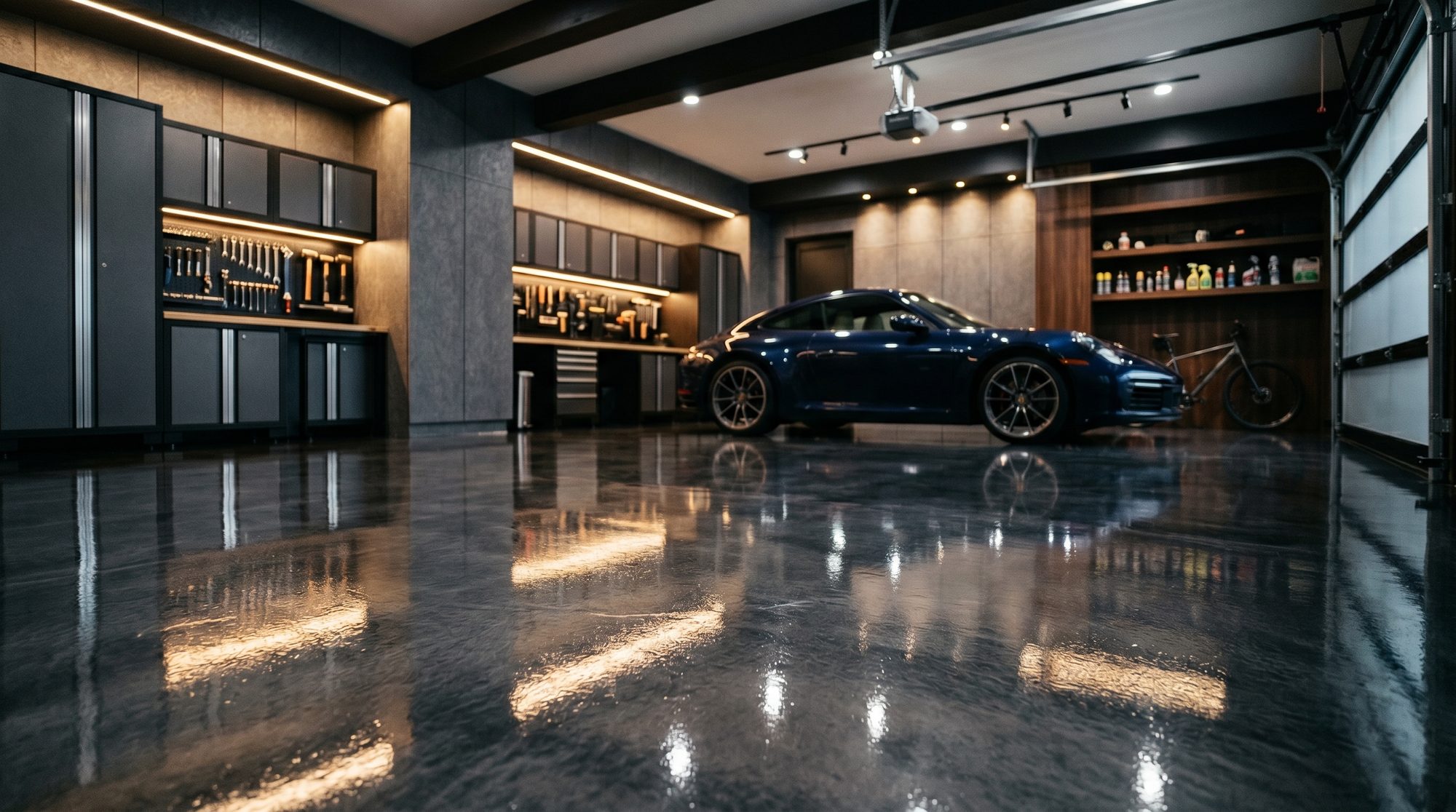
If you're comparing options for garage floor coating in Logan, the good news is that the decision comes down to a handful of things you can actually check: the coating system, the prep work, and the installer's process. This guide walks through all three, plus what tends to drive cost here in Cache Valley — so when you get an estimate (ours are free and on-site), you know exactly what you're looking at.
Epoxy vs. polyaspartic: what actually matters
Almost every professional garage floor in Logan is one of two systems — epoxy or polyaspartic — and plenty of good floors use both, with an epoxy base and a polyaspartic topcoat.
- Epoxy builds thick, bonds hard to properly ground concrete, and is the economical workhorse. Its trade-offs: it cures slowly, it's fussy about cold temperatures during install, and pure epoxy topcoats can amber over time where sunlight hits the slab through an open door.
- Polyaspartic cures fast (often same-day return to service), stays clear under UV, and tolerates a much wider temperature window — useful for Logan's short shoulder seasons. It costs more per coat, which is why it's most often used as the clear topcoat over a flake broadcast.
The honest answer to "which is better?" is that the system should match the space. A daily-driver garage that sees snowmelt and hot tires benefits from a polyaspartic topcoat; a storage bay or basement can be well served by a full epoxy build. A good installer will explain the trade-off rather than push one label. If you want a deeper technical comparison, Concrete Network's polyaspartic overview is a solid neutral reference.
| Factor | Epoxy | Polyaspartic |
|---|---|---|
| Cure / return to service | Slower — often 24–72 hours | Fast — frequently same day |
| UV & color stability | Can amber in direct sun | Stays clear under UV |
| Cold-weather install | Fussy below ~55°F | Wider temperature window |
| Relative cost per coat | Lower | Higher |
| Best role | Thick, economical base coat | Clear topcoat over the flake |
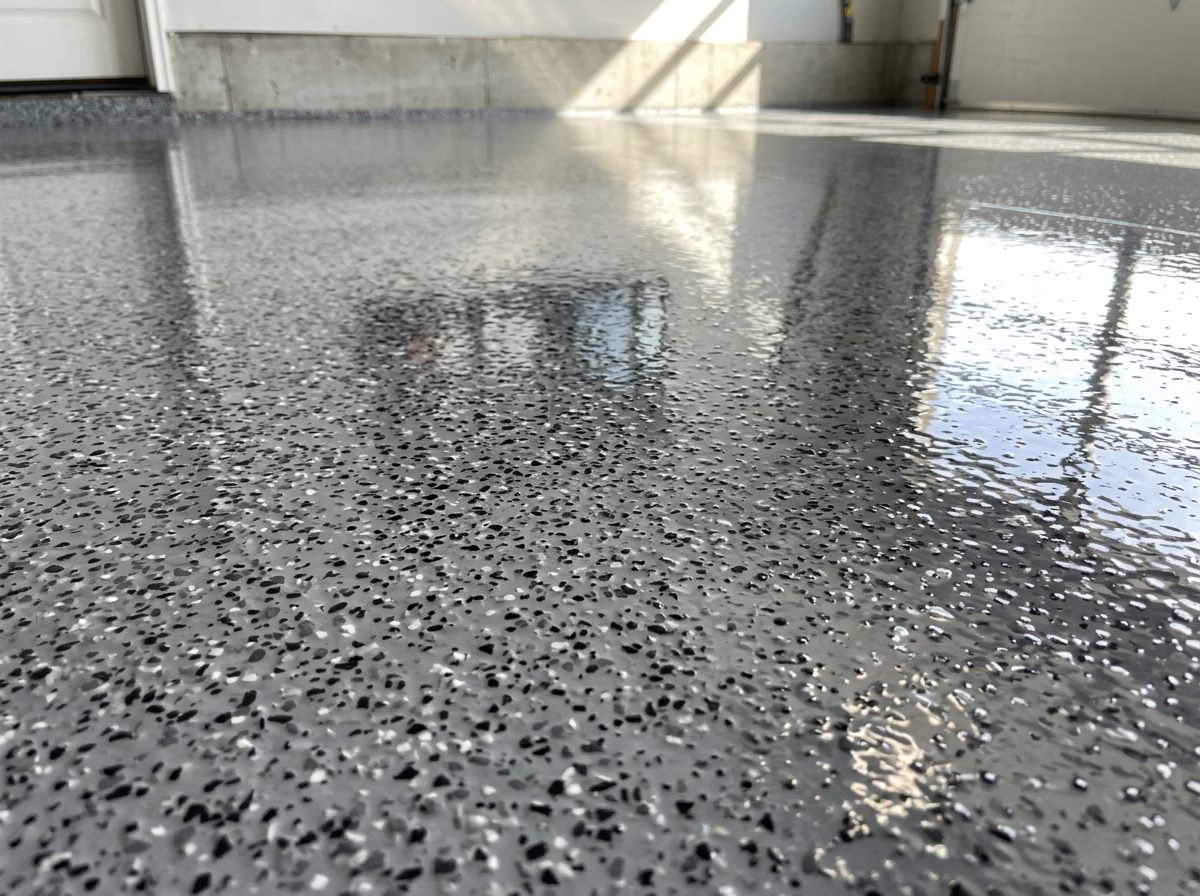
A full-flake system: base coat, broadcast, and clear topcoat.
Logan is harder on bare concrete than it looks
At roughly 4,500 feet on the floor of a cold northern-Utah mountain valley, Logan runs through hard freeze-thaw cycles for a good part of the year. Moisture works into bare concrete, freezes, expands, and slowly opens pits and spalls. Add the snowmelt and road salt that drip off vehicles all winter — salt is rough on unsealed slabs — plus the weeks of trapped grit that settle out of Cache Valley's notorious winter inversions, and an uncoated garage floor here tends to age faster than the same slab would in a milder climate.
A properly installed coating seals the surface, so water, salt, and oil sit on top where they can be wiped or hosed off instead of soaking in. That's the practical case for coating a garage in this climate — it's floor protection first, looks second.
What a proper installation includes
The coating chemistry matters less than what happens before it goes down. When you compare bids, ask each installer to walk you through these steps — the cheap quote usually skips one of them:
- Diamond grinding. The slab gets mechanically ground to open the pores so the coating bonds into the concrete. Acid etching — the shortcut — leaves a weaker bond and is the most common reason floors peel.
- Crack and spall repair. Cracks get routed and filled, pits get patched, so the finished floor is flat and the damage doesn't telegraph through.
- Moisture check. Concrete that's transmitting ground moisture needs a vapor-tolerant base coat, or the floor can blister later.
- Base coat and full flake broadcast. Flake to full rejection (excess flake scraped back) hides slab imperfections and adds texture underfoot.
- Clear topcoat. The wear layer — this is what shrugs off hot tires, salt, and dropped tools. Thickness and type here determine how the floor looks in five years.
Most residential garages are prepped and coated in one to two days, with a short wait before parking on the new surface.
What does a garage floor coating cost in Logan?
Every honest answer starts with "it depends," because three things move the number: square footage, the condition of the slab (repair work adds labor), and the system you choose (a polyaspartic topcoat costs more than a straight epoxy build). National cost guides such as Thumbtack's epoxy flooring data put a typical professionally installed two-car garage in the low-to-mid thousands, and that's a reasonable frame for this market too.
| Garage size | Typical installed range* |
|---|---|
| 1-car (~250 sq ft) | $1,500 – $3,000 |
| 2-car (~400–500 sq ft) | $2,500 – $5,500 |
| 3-car (~600–750 sq ft) | $4,000 – $8,000+ |
| Basement / shop floor | Priced per square foot after a look at the slab |
*Ballpark ranges for a professionally installed flake system with proper diamond-ground prep. Heavy slab repair or a full polyaspartic build runs higher; a bare-bones DIY kit runs lower but rarely lasts. Your written on-site quote is the only number that actually applies to your floor.
Be careful comparing a professional install against a hardware-store DIY kit on price alone — the kits use thinner coatings over minimal prep, which is exactly the combination that leads to peeling within a couple of years in a freeze-thaw climate. The gap in longevity is much bigger than the gap in price.
The only number that actually matters is a written quote for your slab. That's why the on-site estimate is free — square footage gets measured, the slab gets inspected, and you get a clear price with no surprises.
How to vet any installer (including us)
Whoever you call, these four questions separate pros from short-cutters:
- How do you prep the slab — grinding or etching?
- What's the full system build — base coat, broadcast, and topcoat — and what topcoat chemistry do you use?
- How do you handle existing cracks and moisture?
- What does the warranty cover, in writing — and does it cover hot-tire pickup and peeling?
If the answers are vague, keep calling. A crew that's proud of its prep will happily talk your ear off about it.
Logan garage floor questions, answered
How long does a garage floor coating take?
Most residential garages in the Logan area are prepped and coated in one to two days. Fast-cure polyaspartic topcoats can have you walking on the floor the same day, with vehicles back on it shortly after — you'll get exact timing with your quote.
Can you coat an older, cracked slab?
Usually, yes. Cracks are routed and filled and pits are patched during prep. Very heavy damage may call for resurfacing first — that's the kind of thing the on-site provider estimate sorts out before any money changes hands.
Can floors be installed in winter?
Often, yes. Polyaspartic systems tolerate colder installation temperatures than traditional epoxy, which matters in Logan from roughly November through March. Attached, sheltered garages are rarely a problem; timing gets confirmed per job.
What is hot-tire pickup?
When warm tires sit on a poorly bonded coating, cooling rubber can grip and literally pull the coating off the slab. It's a bond failure — almost always traced back to skipped grinding or a thin DIY product — and it's the main failure a properly prepped floor avoids.
Epoxy or polyaspartic for a Logan garage?
For a garage that parks vehicles year-round here, the common recommendation is an epoxy or polyaspartic base with a full flake broadcast and a clear polyaspartic topcoat — the topcoat handles UV and hot tires, the flake hides wear. Storage and interior spaces have more flexibility.
Do you serve areas outside Logan?
Yes — coating crews regularly work in Smithfield, Hyrum, and Providence, and across Cache Valley.